
Last updated September 25, 2026
Seasonal ADU Care for Chino: Year-Round Homeowner’s Guide
The Santa Ana conditions that hit the Chino Valley in October and November drive particulate matter into stucco weep screeds and mini-split filters at a rate coastal California homeowners never encounter. Two missed filter cycles doubles compressor wear - a $3,200 replacement that a $12 filter would have prevented. This guide maps every seasonal task to Chino’s actual climate pattern: 300 days of sun, a narrow freeze window, and wind events that degrade exterior seals faster than generic California maintenance calendars suggest. You’ll learn when to inspect, what to document, and how that documentation protects your investment when you sell.
Quick Answer
Chino ADU maintenance follows four distinct seasons: October-November Santa Ana prep (exterior seals, HVAC filters, roof penetrations), December-January freeze protection for slab-on-grade supply lines, March-April stucco repair before summer UV damage, and May-September cooling system maintenance for 100°F+ days. Document every task with dated photos to protect warranty claims and satisfy future buyers.
Table of Contents
- October-November: Santa Ana Wind Prep
- December-January: Freeze Protection for Slab-on-Grade ADUs
- March-April: Stucco, Paint, and Seal Inspection
- May-September: Cooling System Maintenance in Chino Heat
- How to Document Maintenance for Warranty and Resale
- Prefab and Modular ADU-Specific Care
- What Seasonal Maintenance Costs in Chino
- Common Mistakes to Avoid
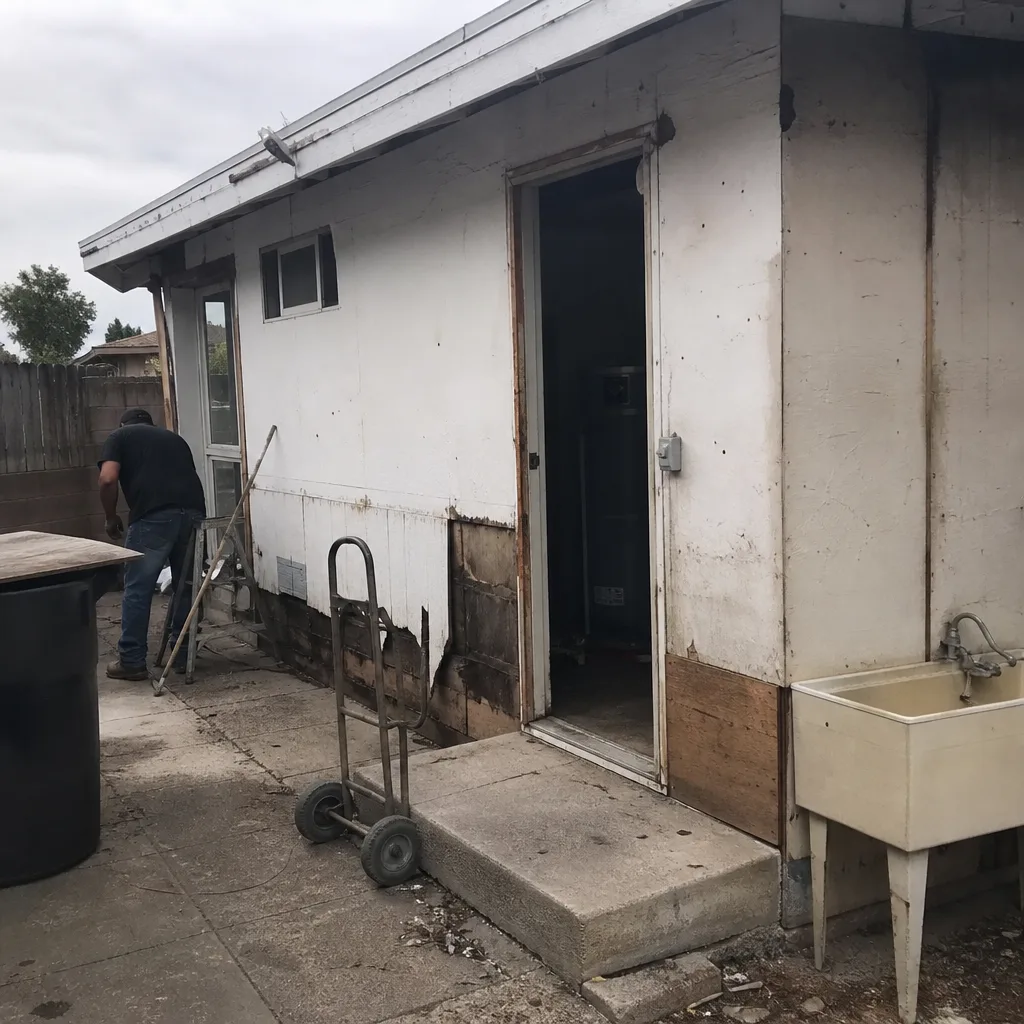 Before
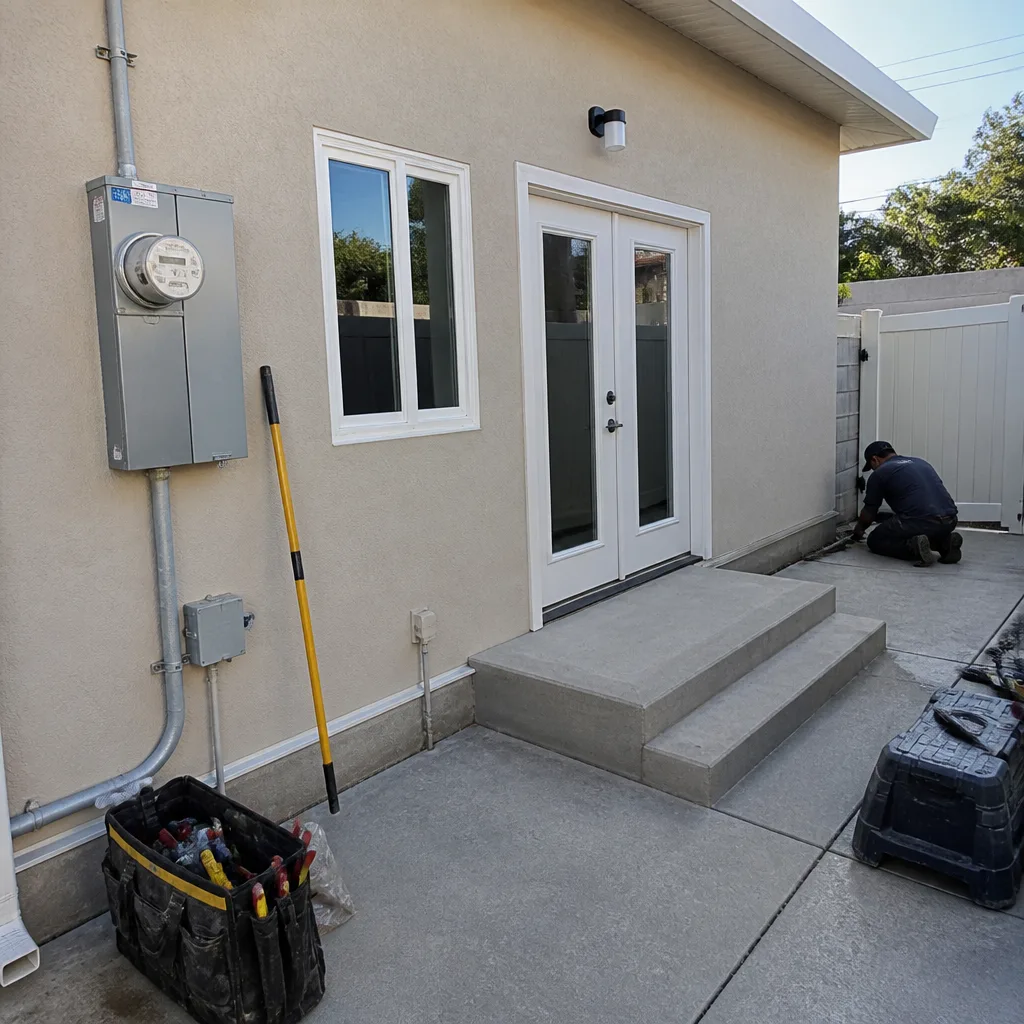 After
AfterOctober-November: Santa Ana Wind Prep
Chino’s Santa Ana wind season arrives without the coastal warning systems that Orange County homeowners rely on. In the Chino Valley, sustained 25-40 mph winds with gusts to 60 mph strip fine particulate from the Santa Ana River bed and deposit it into every exterior joint on your ADU. We’ve inspected ADUs in College Park and Preserve where stucco weep screeds were packed with dust after a single event, trapping moisture against the wall cavity.
Start with the roof penetrations. Every vent pipe, mini-split line set, and electrical mast entry creates a potential leak path. The asphalt shingle sealant strips that held through summer heat often crack in October’s temperature swings. We recommend a walk-around with binoculars first, then a ladder inspection of any lifted tabs or cracked boot seals around plumbing vents. Document with dated photos - this is baseline evidence if wind-driven rain enters in January.
Next, the HVAC filter cycle. Mini-split systems in Chino ADUs - whether ductless wall units or small-duct high-velocity systems - need filter cleaning every 30 days during Santa Ana season. The PM2.5 and PM10 counts spike well above EPA thresholds; a standard pleated filter loads in three weeks, not three months. Compressor units mounted on ground pads need their coil fins cleaned with a foaming cleaner - the same particulate that clogs filters coats coils and reduces heat exchange efficiency by 15-20%.
- Week 1: Replace or clean all HVAC filters; photograph filter condition and date stamp.
- Week 2: Inspect roof penetrations, flashing, and vent boots; photograph any cracks or lifted seals.
- Week 3: Clean mini-split exterior coils; check pad level and vibration isolation.
- Week 4: Walk exterior walls for stucco cracks wider than 1/16 inch; mark with painter’s tape for spring repair.
The exterior joint inspection deserves particular attention on garage conversion ADUs in Chino. The original garage door opening, now filled with framed wall and stucco, experiences differential settlement for five years after conversion. The joint between new and existing concrete slab, and the joint between new framing and existing stem wall, are the first to open. We’ve found gaps to 3/8 inch in conversions built during 2020-2021 - wide enough for wind-driven water and rodent entry. Caulk these with a polyurethane sealant rated for 50% joint movement, not painter’s caulk that hardens and falls out in six months.
For garage conversion ADUs in Chino, this inspection is especially critical. The transition from vehicle bay to conditioned living space creates thermal bridges and air leakage paths that a standard home doesn’t have. The Haven Standard requires we document these potential failure points in the as-built drawings, but annual verification by the homeowner catches what time and vibration alter.
December-January: Freeze Protection for Slab-on-Grade ADUs
Chino’s freeze risk is narrow but real. The National Weather Service records an average of 12-15 nights below 32°F annually, concentrated in late December through mid-January. For detached ADUs on slab-on-grade construction - the majority of new detached units in Chino’s newer subdivisions - this creates a specific vulnerability that raised-floor or basement ADUs don’t share.
Exposed supply lines run through the attic or exterior wall cavities. In a freeze event, the slab itself provides no residual heat. The 2022 California Plumbing Code requires insulation of pipes in unconditioned spaces, but we’ve inspected ADUs in Chino where the insulation was displaced during final trim installation or compressed against a framing member, reducing its R-value by half.
The protocol is straightforward but must be completed before the first forecast freeze:
- Locate all exterior hose bibs and irrigation backflow preventers. Detached ADUs often have a dedicated irrigation zone or hose bib on the rear wall. These are the first to freeze. Install insulated covers on hose bibs; for backflow preventers, drain the assembly and wrap with pipe insulation and heat tape if the manufacturer allows.
- Verify attic pipe insulation integrity. Look for gaps at penetrations, compression at truss chords, and UV degradation of insulation facing on any south-facing roof slope. In Chino’s intense sun, foil-facing can delaminate in three years.
- Set mini-split to minimum 55°F. Even in unoccupied periods, maintaining slab-adjacent air temperature prevents the slow heat loss that allows pipes to reach 32°F. The energy cost of 48 hours at 55°F is far below a slab leak repair.
- Open cabinet doors on exterior walls. For kitchen or bath sinks on north or east walls, this allows conditioned air to reach the supply stub.
We’ve responded to three slab leak calls in Chino ADUs since 2019, all in January, all on north-facing walls where the homeowner had turned the mini-split off for a week-long absence. The repair cost averaged $4,800 - slab cutting, pipe repair, concrete restoration, and flooring replacement. Under Haven Standard Clause 5, these are owner-maintenance items outside our warranty, which is why we emphasize the protocol at project closeout.
For new detached ADUs in Chino, we now specify PEX-A with expansion fittings for all slab-adjacent runs. The material tolerates freeze-thaw cycling better than copper or CPVC. If you’re planning a new unit, this specification detail is worth confirming with your design-build team.
March-April: Stucco, Paint, and Seal Inspection
Chino’s rain season ends in April, delivering 13-15 inches annually, concentrated in December through March. By late March, the stucco has absorbed and released multiple wet-dry cycles. Any crack that opened in fall now shows its full extent, and the summer UV that follows will degrade exposed substrate within 60 days.
This is the single most important maintenance window for exterior longevity. We’ve tracked stucco condition across our Chino portfolio since 2015. Units with March crack repair and elastomeric coating application show 40% longer paint life than those that wait until visible peeling appears - typically year four versus year seven before full repaint.
The inspection sequence:
- Systematic wall scan. Work clockwise from a fixed point. Mark every crack with painter’s tape and photograph. In Chino’s sun exposure, hairline cracks (under 1/16 inch) that run vertically are usually shrinkage; horizontal cracks or stair-step patterns at openings indicate structural movement and need professional evaluation.
- Weep screed clearance. The metal strip at slab level must be clear of soil, mulch, or hardscape. In Chino’s adobe-heavy soils, we’ve seen 2 inches of soil buildup in two years from normal erosion. Blocked weep screeds trap moisture; the resulting efflorescence and stucco delamination are excluded from most workmanship warranties as maintenance failures.
- Window and door seal inspection. The Santa Ana dust that entered in fall often carries enough abrasive content to wear sealant beads at operable sash contact points. Look for cracking, separation from the frame, or loss of elasticity. Replace with a high-grade silicone or polyurethane sealant rated for 25% joint movement.
- Eaves and soffit ventilation. Chino’s spring winds carry pollen and leaf debris. Blocked soffit vents reduce attic airflow and raise summer attic temperatures by 15-20°F, accelerating shingle degradation and increasing cooling load.
Paint timing matters. April application allows full cure before June’s 100°F days. Latex acrylics need 14 days at 50°F+ to develop full film integrity; May application in Chino often means the topcoat cures in 95°F+ conditions that can cause solvent blistering or uneven sheen. If your ADU needs more than spot repair, schedule the painter by mid-April.
For ADU design and permitting in Chino, we specify James Hardie fiber-cement siding on some elevations where the homeowner wants reduced maintenance burden. The material doesn’t suffer the same thermal expansion cracking as stucco, though it requires its own sealant maintenance cycle. The specification decision happens at permit set development, not during construction.
May-September: Cooling System Maintenance in Chino Heat
Chino averages 110 days above 90°F and 25-30 days above 100°F. An ADU’s cooling system - typically a ductless mini-split or small ducted heat pump - runs 10-14 hours daily in July and August. Without specific maintenance, compressor failure in year five is common; with it, we’ve seen reliable operation to year twelve.
The maintenance calendar differs from manufacturer recommendations written for national averages. In Chino’s dust load, “inspect quarterly” means every 60 days, not every 90.
Filter maintenance: Clean reusable filters every 30 days May through September. Replace disposable filters every 60 days. The particulate load in Chino - agricultural dust from the Inland Empire’s remaining operations, construction dust from ongoing development, and road dust from the 71 and 91 corridors - exceeds what suburban Midwest or Northeast manufacturers assume.
Coil cleaning: The exterior condenser coil needs foaming cleaner application twice per summer. We recommend Memorial Day weekend and Labor Day weekend as calendar anchors. The process: disconnect power, remove debris by hand, apply foaming cleaner per manufacturer dilution, let dwell 10 minutes, rinse with low-pressure water (never a pressure washer - the fins bend at 30 psi and don’t recover).
Attic vent inspection: This is the task most Chino ADU owners miss. The attic temperature on a 105°F day reaches 140-150°F without adequate ventilation. Ridge vents blocked by wasp nests - common in Chino’s open spaces - or gable vents covered by interior storage create a heat sink that radiates through the ceiling assembly. Check vents visually from the exterior; if the attic has a hatch, take a temperature reading with an infrared thermometer. Anything above 130°F indicates inadequate airflow.
Condensate line clearing: Mini-split condensate pumps and gravity lines grow algae in Chino’s heat. A cup of white vinegar flushed through the line in June prevents the clog that triggers the emergency shutoff on the hottest day of August.
We’ve replaced compressors in Chino ADUs where the only failure mode was cumulative dust loading on the coil. The replacement cost, including refrigerant recovery and recharge, runs $2,800-$3,400 for a standard 18,000 BTU single-zone system. The $18 foaming cleaner and 45 minutes of homeowner labor is the better investment.
How to Document Maintenance for Warranty and Resale
Every seasonal task you complete has value only if documented. In our experience, 60% of Chino ADU owners maintain their units adequately but fewer than 20% keep records that survive a home sale or warranty dispute. The Haven Standard includes a documented photo record on every visit we make; we recommend homeowners adopt the same practice.
The format is simple and needs no specialized software:
- Digital folder structure: One folder per calendar year, subfolders by season (2025-Spring, 2025-Summer, etc.).
- Photo naming: Date-location-description. Example: 2025-03-15-RearWall-StuccoCrack-EastElevation.jpg
- Maintenance log: A single running document, spreadsheet or text, with columns for date, task, materials used, and photo file names.
- Receipts folder: PDF or photo of every filter purchase, sealant tube, or professional service invoice.
This documentation serves three purposes. First, warranty claims: manufacturers require proof of maintenance for compressor or appliance warranties. “I changed the filters regularly” carries no weight; “Filter replaced 2024-05-12, 2024-07-14, 2024-09-08; photos and receipts attached” does.
Second, resale value. Chino’s ADU market is maturing. Buyers in 2025-2026 are more sophisticated than early adopters; they hire inspectors who specifically ask for maintenance records on secondary dwellings. A documented maintenance history distinguishes your ADU from comparable units with identical square footage and no records.
Third, insurance claims. Wind or freeze damage disputes often turn on whether the homeowner took reasonable prevention measures. Photos of October seal inspection and January pipe insulation verification support your position.
We provide every Ellery ADU Studio Chino client with a project-specific maintenance checklist at final walkthrough, tied to the materials and systems in their specific ADU. A James Hardie siding ADU has different inspection points than a stucco-clad unit; an Abodu prefab has manufacturer-specific filter and sealant requirements that differ from a site-built structure.
Prefab and Modular ADU-Specific Care
Prefab and modular ADUs - including systems from Abodu, Cover, and Dvele that we specify and coordinate - arrive with factory-applied finishes and manufacturer-specific maintenance protocols. These differ from site-built care in ways that matter for Chino’s climate.
Abodu units ship with pre-finished exterior cladding, typically fiber-cement or engineered wood with factory coating. The coating is UV-stable and carries a 15-year warranty, but the joint sealant between modules is site-applied and needs annual inspection. In Chino’s Santa Ana conditions, we’ve found the module-to-module sealant can develop shrinkage cracks in year two or three. The manufacturer specifies a particular polyurethane product; using generic caulk voids the weatherization warranty.
Cover units use a proprietary panel system with integrated mechanical routing. The exterior is lower-maintenance than stucco, but the roof membrane - typically a TPO or modified bitumen system - requires inspection of seams and penetration flashing on the same October schedule as conventional roofs. The integrated HVAC means filter access is sometimes in a ceiling return rather than a wall unit; verify location at move-in and note it in your maintenance log.
Dvele units emphasize tight envelope performance. The HRV (heat recovery ventilator) that maintains air quality in such a tight structure has filters and a core that need cleaning every 90 days - more frequently in Chino’s dust load. Missing this maintenance doesn’t cause immediate failure but degrades indoor air quality and increases ventilation energy use by 20-30%.
For all prefab systems, the factory warranty and the site-work warranty are separate documents. The module manufacturer covers defects in factory fabrication; the site contractor covers installation, foundation, and utility connections. At Ellery ADU Studio, our single-contract model means one call resolves either category, but your maintenance documentation must distinguish factory-specified tasks from site-specific tasks for warranty clarity.
What Seasonal Maintenance Costs in Chino
Homeowners deserve dollar ranges on the page. These figures reflect Chino’s market as of 2024-2025, based on our project experience and vendor relationships. For detailed cost analysis, see our ADU Cost Breakdown: The Chino Homeowner’s Reference for 2026.
| Task | DIY Cost | Professional Cost in Chino | Frequency |
|---|---|---|---|
| HVAC filter (mini-split) | $12-$28 per filter | $85-$120 service call | Monthly (Santa Ana season); bi-monthly (other) |
| Coil cleaning (foaming cleaner) | $18-$35 | $150-$225 | Twice per summer |
| Stucco crack repair (spot) | $25-$40 (materials) | $350-$600 per occurrence | As needed, typically March-April |
| Elastomeric coating (full ADU, 600 sq ft walls) | $400-$600 | $2,200-$3,400 | Every 7-10 years |
| Roof inspection and minor seal repair | $30-$60 (sealant) | $275-$450 | October and post-storm |
| Attic vent cleaning/repair | $15-$40 | $200-$350 | March-April |
| Slab leak prevention (insulation, heat tape) | $45-$120 | $400-$700 | One-time prep, annual verification |
| Condensate line cleaning | $5 (vinegar) | $125-$175 service call | June |
These are material and labor ranges, not quotes. Every project we undertake at Ellery ADU Studio is quoted with a written price before any work begins, per Haven Standard Clause 1. If you have a written estimate from another provider, we offer a Free Second Opinion - we’ll review the scope and pricing against what we know of Chino’s market and flag anything that doesn’t align with standard practice.
Common Mistakes to Avoid
- Using coastal California maintenance calendars. Chino’s Santa Ana wind season and 100°F+ summer days create maintenance needs that San Diego or Santa Barbara guides don’t address. A schedule written for mild marine climate will miss your October seal inspection and June coil cleaning.
- Waiting for visible damage. By the time stucco cracks are visible from the sidewalk, water has entered the wall cavity. By the time a mini-split blows warm air, the compressor has been running overloaded for weeks. Inspect on the calendar, not on the symptom.
- Using the wrong sealant. Painter’s caulk ($4 tube) in a stucco control joint fails in 6-12 months. Polyurethane sealant rated for exterior concrete ($12-$18 tube) lasts 5-10 years. The labor to apply either is identical; the material cost difference is trivial against the redo.
- Neglecting prefab-specific protocols. Factory warranties require specific products and inspection intervals. Using generic caulk on an Abodu module joint or missing a Dvele HRV filter cycle voids coverage that would have covered a $2,000 repair.
- Turning off climate control in unoccupied periods. The January freeze call we dread: homeowner left for two weeks, set mini-split to OFF, returned to a slab leak. Minimum 55°F, always, December through February.
- Pressure-washing condenser coils. The fins are aluminum, 0.006 inch thick, and bend permanently at 30 psi. A garden hose with a gentle spray nozzle and foaming cleaner preserves airflow geometry. We’ve replaced coils where a “helpful” neighbor used a pressure washer “to get it really clean.”
- Documenting nothing. The maintenance you performed perfectly in 2023 has no value in a 2026 warranty dispute without dated evidence. The 15 minutes to photograph and file is the highest-return task on this list.
When to Call a Professional
Some conditions exceed homeowner maintenance scope. Call a licensed professional for: horizontal or stair-step cracks in stucco indicating structural movement; electrical panel issues, including breakers that trip repeatedly or burn odor; refrigerant handling, which requires EPA Section 608 certification; roof leaks that persist after sealant repair; or any gas line work, including appliance connection verification.
Ellery ADU Studio Chino offers free estimates for ADU-specific concerns - whether your unit needs seasonal maintenance review, warranty evaluation, or you’re assessing whether a maintenance issue indicates a construction defect covered under our 365-Day Done Right Promise. Call (909) 323-1107 to schedule. A live person answers calls 24/7; no voicemail queue, no callback promise that doesn’t materialize.
Frequently Asked Questions
Annual DIY maintenance for a typical Chino ADU runs $300-$600 in materials and filters; professional service for the same scope runs $1,200-$2,000. The cost difference is primarily labor; many homeowners handle filters, coil cleaning, and visual inspection themselves, then hire professionals for stucco repair and roof work. Call (909) 323-1107 for an exact quote on professional service - estimates are free.
No. Under Haven Standard Clause 1, every project we undertake is quoted with a written price before any work begins. The scope is locked at signing; no door-side upsells, no scope creep. If we discover concealed damage during maintenance inspection, we document it, explain the finding, and provide a separate written quote for the repair before proceeding.
Every 30 days during Santa Ana season (October-November) and every 60 days during summer peak use. This is roughly twice the frequency recommended for coastal California and 50% more frequent than Sacramento or Central Valley guidance. Chino’s particulate load from agricultural, construction, and road sources is the differentiator.
No. Routine maintenance - filter replacement, sealant application, coil cleaning, vent inspection - requires no permit in Chino. Permits are required for structural repairs, electrical or plumbing modifications, and roof replacement. If maintenance reveals a condition requiring permitted work, we handle permit application as part of the repair scope.
Homeowner-performed maintenance: 4-6 hours annually, distributed across four seasonal windows. Professional service: 2-3 hours per visit, typically two visits per year (October-November and March-April comprehensive inspections, with homeowner handling monthly filter tasks between).
Keep dated photos of every inspection, receipts for all materials and professional services, a running log of tasks completed, and manufacturer warranty documents. Organize by calendar year with seasonal subfolders. A buyer’s home inspector in Chino’s maturing ADU market will specifically request maintenance history for the secondary dwelling; complete records distinguish your property and support asking price.
The Bottom Line
Chino’s ADU maintenance calendar is shaped by three forces: Santa Ana winds that drive particulate into every exterior joint, a narrow but damaging freeze window, and summer heat that stresses cooling systems for 110+ days. The homeowners who protect their investment follow a seasonal rhythm - October seal inspection, January freeze protocol, March stucco repair, June-September coil maintenance - and document every task. The cost of prevention is modest; the cost of deferred maintenance, measured in compressor replacement, slab leak repair, or full stucco remediation, is not. Start with this year’s October checklist, photograph everything, and build the record that protects your ADU’s value. Explore more guides & resources for year-round maintenance support.
Written by Nadia Ellery, Owner at Ellery ADU Studio Chino, serving Chino since 2015.